Let me try to explain it...
First, here's the picture of the photoresistor circuit:
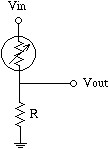
Now, for a start, imagine the side-branch to V-out isn't there.
As you probably now, voltage in series adds up, so V-1 + V-2 = V-total
You have a total voltage of 5V between V-in and ground, so the total voltage across both the variable resistor and the fixed resistor together is always 5V.
When the resistance of the photoresistor changes, so does the division of the voltage between the two resistors.
e.g. If for a certain condition the photoresistor has a resistance of 1.6 kohm, and you have fixed resistor of 1.6 kohm then there would be an equal voltage of 2.5V across both the resistors. Together this would make 2.5 + 2.5 = 5V total voltage.
Another example, if the photoresistor has a resistance of 4.8 kohm, with the same fixed resistor, then you'd have a division of 3,75V across the photoresistor and 1,25V across the fixed resistor. Together always counting up to the total 5V.
It is all relative, you take the total resistance as 100%, across which there is a 5V voltage. If the photoresistor has 75% of total resistance then it has 75% of the 5V, so 3,75V. Same for the fixed resistor.
So now that you now about the division in voltage, here is where the side-branch comes into play.
Of course you want to measure the voltage across the photoresistor to determine how much light there is.
The side-branch brings out the voltage that's left after the photoresistor to V-out.
Across the photoresistor you have for example a voltage of 3V, then there is a voltage of 2V left over at the junction. Seeing as V-1 = V-2 = V-total in parallel (the voltage in all the branches is the same as the total voltage). So the voltage of 2V is lead to V-out whilst still also being across the fixed resistor.
Now, you can see why the V-out increases with light. This is because the photoresistor decreases in resistance with light and thus has a lower voltage across it, resulting in a bigger part of the 5V being left over after the photoresistor.
Your choice of the fixed resistor depends on the range of values that the photoresistor has for the different light conditions you want the sensors to operate in.
Hope this helps you.

